Sentire Dynamics
Regulation is a universal principle.
We coded it for machines first.
Now we are bringing it back to where it came from: the human body.
Regulatory status
Guardian Brain V1 is a research prototype. It is not a medical device and holds no CE, FDA or equivalent certification. It is not intended to diagnose, treat, mitigate or prevent any disease. Everything on this site is research and scientific disclosure. A patent application is in preparation.Confidentiality
Detailed architecture, calibration parameters, datasets and firmware remain trade secrets of Sentire Dynamics pending patent filing. This site presents the approach and the concept, not the protected implementation.© 2026 Sentire Dynamics
Cyber Parc Hammam Sousse, Office 37, Tunisia · [email protected]Background image: AI-generated illustration, not a product photograph.
A SAFETY LIMIT FOR DEVICES THAT STIMULATE THE BODY
Wearables that vibrate or stimulate the nervous system are multiplying, and more of them are driven by adaptive algorithms or AI. The ones we have examined do not limit how much stimulation a person receives over hours and days.
Guardian Brain is a research wearable built around such a limit. It estimates heart-rate variability beat by beat, keeps a running measure of cumulative load, and gates two haptic actuators — at the nape and the forehead — through a small, fixed safety layer that no upstream logic can override at runtime.
Not a breathing coach. Not a stress score. A safety coprocessor for devices that touch the nervous system.
The principle: bounded release, not suppressionSummary
This work started from a long personal practice of somatic self-regulation. It led to a working hypothesis: that some forms of autonomic dysregulation and some forms of mechanical resonance can be described by the same mathematics. The hypothesis is set out in a working paper. Its engineering consequence — a safety layer that bounds cumulative energy — was first built and tested on a 3D printer (Guardian X), and is now implemented on a wearable (Guardian Brain).1. One pattern, two substrates (hypothesis)
In many dynamic systems, unregulated excitation can settle into self-sustaining oscillation. In a machine, this shows up as residual vibration after the command stops. In physiology, we hypothesize an analogue: a nervous system that stays in sympathetic activation after the stimulus is gone. The working paper models both with the same equations. Whether the physiological side holds is what our pilot is designed to test.2. Why suppression is not enough
A common engineering answer to vibration is stiffness: heavier frames, capped accelerations. It works until the most demanding regimes. We look for the alternative: regulating the signal itself, within hard bounds.3. The principle: bounded counter-information
Our design rule: a system under unregulated load should receive only bounded, time-limited intervention, triggered by a measured cumulative energy, and executed by an architecture that keeps optimization strictly separate from safety. The idea is inspired by rhythmic somatic practices such as alternating tapping; we make no claim about their clinical efficacy.4. The BTR meta-law
Every actuator output of a Guardian system — a motor command or a vibration on the skin — is the product of an intent and a safety authority:
u_out(t) = α(t) · u_in(t), with α(t) between 0 and 1.
α(t) is set by a small state machine (nominal → collapse → recovery → nominal) driven by a leaky integral of cumulative energy, with fixed thresholds and a minimum recovery time. BTR (Bounded Transient Release) does not optimize anything. It only bounds.5. The bifurcation hypothesis
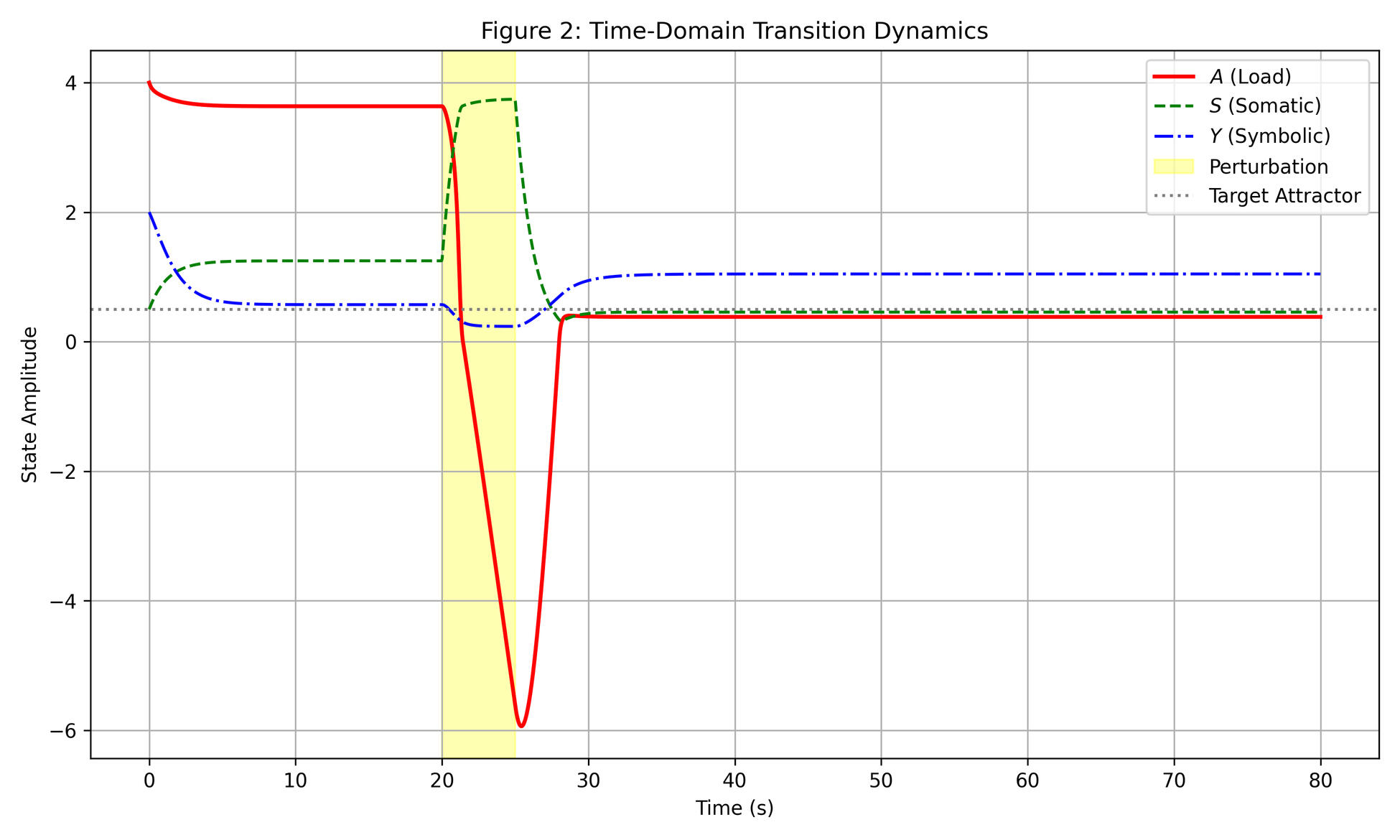
Our underlying model (the Affective–Somatic Collapse model) proposes that the autonomic nervous system can behave as a bistable system, and that a bounded perturbation above a threshold could shift it from one state to the other. This is a falsifiable prediction, not an established result. Guardian Brain is built to test it.6. Two domains, one layer of physics
Domain 1 — intent. Everything that can adapt: stimulation frequency, amplitude, timing. Replaceable.
Domain 2 — safety. The energy state machine. Independent of the stimulation parameters, aware only of its energy integral and thresholds. Its thresholds are compiled into read-only memory and cannot be changed while the device runs.
Layer 0 — physics. A temperature probe on each actuator. If either reads 45 °C or more, or stops responding, the firmware opens a power switch (MOSFET) that cuts actuator power.In a device that touches the body, we don't rely on the controller being smart. We give it limits it cannot exceed.7. Closing the loop
A hypothesis born from somatic practice was coded to stabilize machines. On a 3D printer, the safety layer did what it was designed to do. The next step is to test it on the body, under a pre-registered protocol. Guardian Brain is not a therapeutic product. It is a research instrument, and the first falsifiable implementation of the ASC model.
GUARDIAN BRAIN V1 — A WEARABLE BUILT AROUND A SAFETY LIMIT
Estimate autonomic load. Bound the stimulation. Document what happens.
Most consumer wearables estimate stress with proprietary algorithms and suggest you breathe. Guardian Brain suggests nothing. It reads your heartbeat intervals one by one, keeps a running measure of cumulative load, and only authorizes stimulation within fixed bounds — the way an industrial safety coprocessor gates a machine.
1. Everything runs on the device
A single ARM Cortex-M7 microcontroller (600 MHz) runs the whole loop — from heartbeat intervals to actuator output — in a 100 Hz safety cycle: artifact rejection (Lipponen & Tarvainen 2019), heart-rate-variability estimate, energy integration, and the BTR state machine. No cloud, no network dependency in the safety loop. Safety limits are applied locally on every 10 ms cycle.2. Heart sensing: a standard chest strap
Beat-to-beat intervals come from a Polar H9 chest strap (≈1 ms resolution), relayed over Bluetooth by an ESP32-C3 gateway to the microcontroller. Using a validated commercial sensor lets us focus on the safety layer; all processing that matters for safety stays on the device.3. Vibrotactile stimulation at the nape and the forehead
Two linear resonant actuators (repurposed Apple Taptic Engines), driven at their measured resonances (≈131 Hz), are embedded in a silicone harness: one at the nape, one on the forehead. The placement comes from a personal somatic practice of alternating nape–forehead tapping; the device does not claim to reproduce its effects — it measures and documents.4. Fixed thresholds, no runtime learning
Safety thresholds are set before use and compiled into read-only memory, protected by the microcontroller's memory protection unit. Changing them requires recompiling and reflashing the firmware: no serial command, no over-the-air update and no algorithm can alter them while the device runs.5. Status — October 2026
Firmware: safety layer running; automated bench tests passing (8/8). A heart-sensing chain test in September found six defects in the artifact filter; the fix is in the next firmware revision.
Wearable: silicone harness cast in October 2026 with both actuators and temperature probes embedded; acceptance tests in progress.
Next: 58-day single-subject pilot, pre-registered on OSF, planned for early December 2026. Extension to more subjects only under an ethics-approved protocol.
Path to medical certification, if pursued, comes after the science, not before.Demo video · Pilot protocol (OSF) · Working paper (Zenodo)
The teamRACHIK SOUILAH
Founder — Systems & Hardware Architect
Rachik designs the circuits, writes the firmware, builds the test rigs and casts the silicone. Before Sentire Dynamics he ran a silicone-mould making business. The approach comes from a personal practice of somatic self-regulation, formalized into the BTR principle, tested on Guardian X (Protocol A, April 2026), and now implemented in Guardian Brain.
Rachik is also the subject of the first single-subject pilot. Being both designer and subject is a known source of bias; full blinding is impossible. The protocol limits it with pre-registration, a randomized block order drawn by a third person, no-stimulation control blocks, automated analysis fixed in advance, and stopping rules. The principle behind it is simple: we will not ask anyone to wear a protocol we have not worn ourselves.METHOD
AI assistants are used as reviewers: firmware audits, test-data checks and document review. Design decisions, hardware and builds are human.
From machine to body — and why we started with the machineA hypothesis is not a proof. Before putting the BTR layer on a person, we required it to work on a system where every variable can be measured and every failure counted.Guardian X — the machine test
Guardian X is a safety coprocessor for 3D printers. It measures print-head vibration at 3.2 kHz, integrates cumulative vibrational energy, and applies the same bounded authority.
In Protocol A (April 2026), we compared 5 print runs with the coprocessor and 5 without. With it, the drift rate of vibration was halved (ON/OFF ratio 0.50; complete separation between groups, one-sided Mann–Whitney p = 0.004). Our target was a 4× reduction; we reached 2×.What this establishes
1. Optimization and safety can be strictly separated on real hardware.
2. The integrator, state machine and actuation run together in real time on one embedded microcontroller.
What it does not establish: anything about human physiology. That is the next test.Guardian Brain — the body
The same architecture now runs on a wearable. The 58-day single-subject pilot alternates 14-day blocks with the device active and with stimulation disabled (same device worn, safety layer computing, no output), in a randomized order, with the analysis fixed in advance. It is pre-registered on OSF.